Shandong Jilu Automobile Modification Co., Ltd.


How Conveyor-Belt Garbage and Sludge Transfer Vehicles Work
Quick answer: A conveyor-belt garbage and sludge transfer vehicle uses a powered belt inside an enclosed cargo body to move material during loading or unloading. Buyers should verify the actual waste or sludge characteristics, belt and body compatibility, cover sealing, discharge interface, forward and reverse control, cleaning access, chassis configuration, and destination regulations before selecting a vehicle.
Municipal waste and sludge transfer operations are not uniform. Material can range from relatively dry solid waste to wet, sticky, corrosive, or mixed loads. A vehicle that works for one stream may not be suitable for another. The correct configuration therefore begins with the material and the transfer station—not with a generic capacity figure.
How does a conveyor-belt transfer vehicle operate?
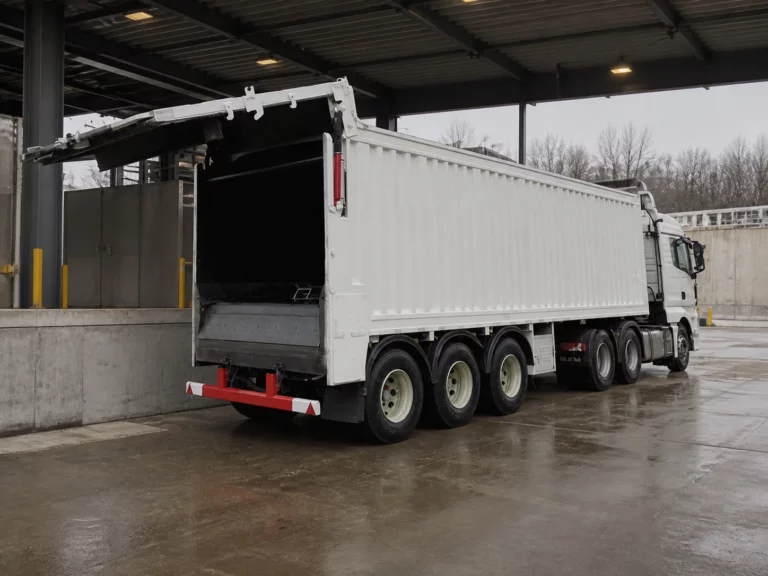
The cargo body contains a wide conveyor system that moves material toward or away from the rear opening. Depending on the configuration, forward and reverse movement can support unloading and loading operations. An enclosed or hydraulically operated cover can help isolate the load during transport, while remote control and monitoring can allow the operator to observe the process from a safer position.
The PG9409ZLJ intelligent conveyor-belt garbage and sludge transfer vehicle product page describes an effective internal belt width of about 2200 mm, forward and reverse operation, remote control and monitoring, and a hydraulic environmental-protection cover. It also states that the listed design is intended to reduce residual cargo and secondary carriage cleaning. These statements apply to the described product configuration and should be verified against the final specification and the buyer’s actual material.
Which materials need the most careful review?
Sludge and mixed waste can place demanding loads on the belt, body, sealing, and cleaning system. Before requesting a quotation, provide representative information or samples where possible.
Material characteristics to define
- Waste or sludge type and source
- Typical and maximum bulk density
- Moisture content or solids percentage
- Particle size and presence of large objects
- Stickiness and tendency to bridge
- Corrosive, abrasive, or chemically active components
- Operating temperature
- Odor, dust, or leakage-control requirements
- Required cleaning and disinfection process
Do not assume that the word “sludge” provides enough technical information. Wastewater sludge, industrial residue, dredged material, and mixed municipal loads can behave differently and may be governed by different transport rules.
Seven system areas buyers should inspect
1. Belt width, material, and traction
The belt must suit the material’s weight, moisture, temperature, and abrasiveness. Ask how the belt is supported, tensioned, inspected, and replaced. Confirm how the system behaves with sticky or uneven loads and what limits apply to large objects.
2. Body shape and usable volume
Body dimensions should be evaluated with the real material density and legal chassis limits. A high nominal volume may not be usable when the material is dense. Internal corners and transition areas also affect residual material and cleaning access.
3. Rear opening and receiving interface
Confirm the rear-door geometry, discharge height, opening clearance, and alignment with the transfer station, pit, container, conveyor, or processing line. The receiving system must accept the actual discharge flow.
4. Cover and sealing strategy
Review the cover operation, side and rear sealing, drainage or liquid-control provisions, and inspection points. The required containment level depends on the material and local environmental rules. A supplier should not select sealing requirements without knowing the waste stream.
5. Control and monitoring
Define which functions need forward and reverse operation, remote control, emergency stopping, cameras, or display monitoring. The operator should be able to understand belt movement and the discharge zone during the entire cycle.
6. Cleaning and maintenance access
Ask how workers reach the belt edges, rollers, rear transition, body corners, cover, and drainage points. Establish the cleaning method, safe isolation procedure, and inspection frequency before the vehicle enters service.
7. Chassis and route compliance
Verify the final chassis, axle count, axle loads, tires, suspension, braking, overall dimensions, gross mass, and registration requirements for the destination. The correct body must be matched to a legal and serviceable vehicle platform.
Why forward and reverse operation can matter
Bidirectional belt movement can support different stages of material handling, but its function must be defined for the specific loading and unloading layout. Buyers should ask for an operating sequence showing the belt direction, rear-door position, cover status, operator location, and receiving equipment for every step.
Control logic should prevent accidental operation in an unsafe configuration. Exact interlocks and emergency systems vary by vehicle, so they must be confirmed from the supplied design and manual.
Procurement checklist for a waste or sludge transfer vehicle
- Provide a detailed material description and representative operating data.
- State the required payload, volume, and daily cycles.
- Share loading and unloading station drawings or photos.
- Define leakage, odor, dust, and cover requirements.
- Confirm belt direction, control, camera, and emergency-stop needs.
- Specify cleaning chemicals, water pressure, and access requirements where applicable.
- Confirm route, climate, road condition, and destination regulations.
- Request material-compatibility confirmation and a final technical drawing.
- Review routine maintenance tasks and spare-part availability.
- Agree on site commissioning and operator documentation if required.
Frequently asked questions
Can the same vehicle transport both garbage and sludge?
Not automatically. Compatibility depends on density, moisture, particle size, chemical composition, sealing, belt design, and cleaning requirements. Each intended material should be reviewed before use.
Why use a conveyor belt inside the body?
The belt provides powered, directed movement toward the discharge opening. A bidirectional configuration can support forward and reverse material movement. Actual benefits depend on the body design, material, controls, and transfer-station layout.
Does an enclosed cover guarantee leak-free transport?
No. A cover is only one part of containment. Rear-door sealing, body joints, drainage, material fluidity, operating procedure, and maintenance all affect leakage control. Requirements must be matched to the waste stream and local rules.
What information is needed for an accurate quotation?
Provide the material type, density, moisture, particle size, chemical characteristics, payload, daily cycles, route, destination regulations, loading equipment, receiving system, discharge height, sealing requirements, and cleaning process.
In short
A conveyor-belt garbage and sludge transfer vehicle is a material-handling system on a vehicle chassis. Reliable selection requires the buyer and supplier to define the waste stream, belt and body, containment, loading and unloading interface, controls, cleaning process, route, and legal configuration as one complete application.
Source note: Model-specific statements are based on the PG9409ZLJ intelligent conveyor-belt garbage and sludge transfer vehicle product page. General requirements in this guide are procurement considerations and do not replace a project-specific engineering review, operating manual, or local regulatory assessment.